
Housing DTU
A zero-brokerage, verified student-housing marketplace — from a frustrating PG hunt to 3,000+ active users.
On a campus of 10,000+ DTU students.
Students coming back month over month.
At launch, with zero paid spend.
In 2 weeks after shipping flatmate matching.
The problem
PG hunting was a hustle
Three years ago, my friends and I were fresh admits to DTU, hunting for a PG near campus. Listings on the big property portals were unreliable — misleading photos, outdated rates, wrong locations. We ended up searching offline for days, 3–4 hours at a time, and settled for one more out of exhaustion than confidence.
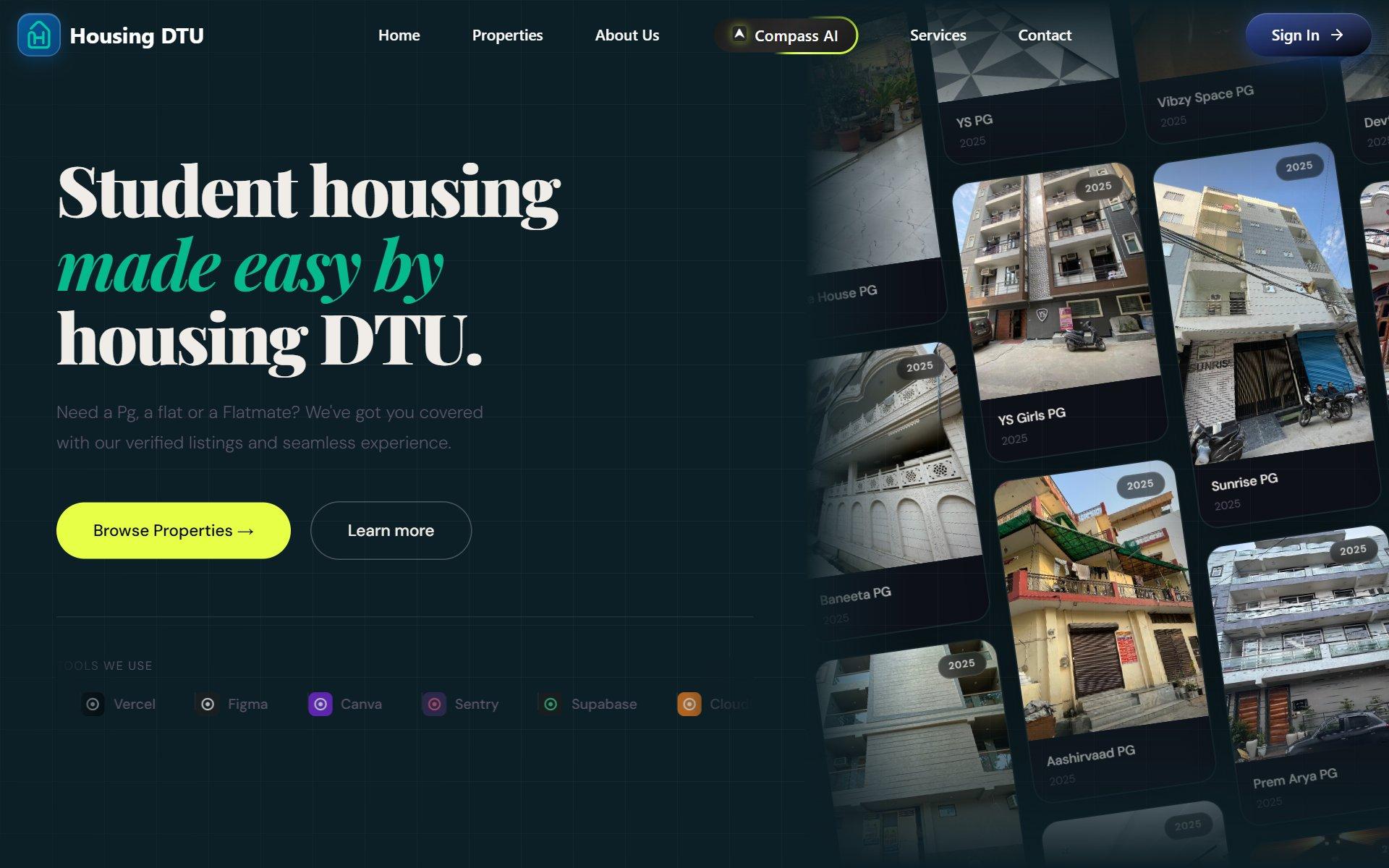
The idea: a platform listing every nearby PG with verified location, images, video, amenities, contact details and rent — all checked by us before it goes live.
Validation
Talking to students before writing code
I talked to as many students as I could and ran a Google Form to widen the sample. Most called PG-hunting “a hustle”, relying on offline visits or hand-me-down PGs from seniors. In all, 100+ user interviews fed a PRD and 7 Figma screens.
The insight that reshaped the product
A student living in a flat told me flat-hunting was worse than PG-hunting — no dedicated listings at all, just broker groups with limited postings and high brokerage. So Housing DTU became a complete, brokerage-free platform for PGs and flats.
Building V1
Built page by page in 2–2.5 months
I started from custom Figma designs, then built the product with Claude Code, page by page — authentication, contact-detail security, a privacy policy and terms. One deliberate investment: a gamified, self-serve listing form so owners could submit every detail themselves, with our team verifying each listing before it went live. The build wrapped by the end of February 2026.
Go-to-market · supply
Earning owners' trust
Attempt one
We went door-to-door pitching PG owners a free listing. Most didn't trust two students with no track record — after dozens of PGs, we had five listings.
What changed
Not the offer — the framing. We ended every pitch with proof: “these properties are already listed with us — look at the pages we build for them.” Social proof and FOMO turned the conversion rate around; owners who'd said no came back.
Cracking flats
Flat owners had no channel reaching them except brokers, whom we'd excluded on purpose. We asked friends for owner contacts and walked area to area looking for “flat for rent” boards. Only 5–6 leads — but they converted well.
Launch · demand
250+ users in 48 hours
With ~12–13 PGs and 5 flats live, we shifted to demand. We designed posters in Canva, papered every corner of campus and backed it with a social push. 250+ users signed up in 48 hours — the first real signal that demand existed beyond our interview sample.
Monetization
Testing willingness to pay
I introduced a ₹199 one-time listing fee per property — deliberately low, designed purely to test whether owners would pay anything at all. Re-pitched with our growth story attached, 12 of ~15 properties approached listed (10 PGs, 2 flats) — a far higher hit rate than the first door-to-door push.
Today 26 owners have paid to list (20 PGs, 6 flats) — ₹5,200 in revenue — and owners have started reaching out to us first.
External validation
Incubated at IIF-DTU
I built a pitch deck and applied to IIF-DTU, our college incubator. After 6–7 selection rounds and a final panel interview, Housing DTU was accepted and pre-seed funded. We were at 1,200–1,300 active users — and for the first time, users and investors had both independently validated what we were building.
The real unlock
Flatmate matching
The signal
Growth had cooled to ~1,500 users. Then I noticed message after message in a college WhatsApp group: “flatmate required, zero brokerage.” We'd been so focused on listings that we'd missed an adjacent, equally real problem — something WhatsApp, LinkedIn and contact-page data all pointed to.
What I shipped — in 5–6 days
- Anyone with a flat can list it for the same ₹199 fee.
- Anyone without one can post a query (name, budget, contact, flatmates needed) or browse existing ones.
- Every submission is verified by a phone call before it goes live — the same trust model as core listings.
The result
- 75–80 new users a day; ~2,000 users within the first 10 days.
- Active users up ~40% in two weeks, average engagement time up 30 seconds.
- Still the sharpest growth lever we've pulled.
A failure
The feature I pulled
Seeing students around me pay steep fees for AI resume tools while chasing internships, I built AI resume, cover-letter, LinkedIn DM and cold-email generation inside Housing DTU. It failed almost immediately — near-zero adoption, high churn. We pulled it after a couple of weeks.
The lesson
A product has to solve one specific problem for one specific audience, with a clear USP. Stretching a platform across unrelated problems dilutes focus until nothing lands. So instead of bolting job tools onto Housing DTU, I spun the idea out as its own sharply-scoped product: Compass AI.
Growth at a glance
From 250 to 3,000+
- 48 hrs post-launch250
- 10–12 days later600
- At IIF-DTU incubation1,200–1,300
- After fee re-onboarding~1,500
- 10 days after flatmate feature~2,000
- Today3,000+
Today: 3,000+ active users at 30% monthly retention, 43 active listings and 24K+ page views. Next up: a proper user dashboard and an integrated online payment gateway.
What users say
“Best part? Zero brokerage! I saved ₹7,000 by finding my flat directly through Housing DTU. The platform is simple, listings are genuine, and everything is verified.”
“Stressed about finding a flatmate for my 2BHK? Housing DTU connected me with a fellow DTU student in just 3 days. Rent split, problem solved!”
“As a fresher, I was lost searching for PGs near campus. Housing DTU showed verified listings with real photos. Contacted the owner via WhatsApp and moved in hassle-free!”
Next case study · PM Internship
Holiday Tribe