
Holiday Tribe
Finding where a travel funnel leaked — then shipping A/B-tested fixes, plus an AI tool sales leadership adopted.
After shipping the new Tara AI flow via A/B test (+50% relative).
Generated per Tara AI session after the new flow.
Lift from the redesigned itinerary page, cookie-randomized A/B test.
Through the Beat the Price Simulator — 60 comparisons a week.
Over the summer I took ownership of three parts of the product: the Tara AI chat revamp, the self-assisted tour package customization flow on the itinerary page, and the competitive “Beat the Price” flow for handling quote-matching requests. Both funnel changes — Tara AI and the itinerary page — shipped behind A/B tests.
Tara AI · conversational funnel
Fixing a 5-message drop-off
The signal
I analyzed 16.8K+ chat messages across 2.8K sessions in SQL and located where users were leaving: around the 5th message of a conversation with Tara AI.
The diagnosis
The drop-off traced back to a top-of-funnel intent mismatch.
What I designed
An intent-triggered questionnaire with context retention.
The result
- Shipped the new Tara flow behind an A/B test.
- Itineraries generated per session up ~50%.
- Itinerary → advisor-call conversion from 40% to 60% (+50% relative).
Self-serve customization
Redesigning the itinerary page
The signal
Funnel and persona analysis pinpointed the itinerary-detail page as the mid-funnel drop-off.
Before
- An oversized main image dominating the centre of the page.
- No way for travellers to customise the trip.
- All content centre-aligned in a single pane.
- A dated, inconsistent colour and design language.
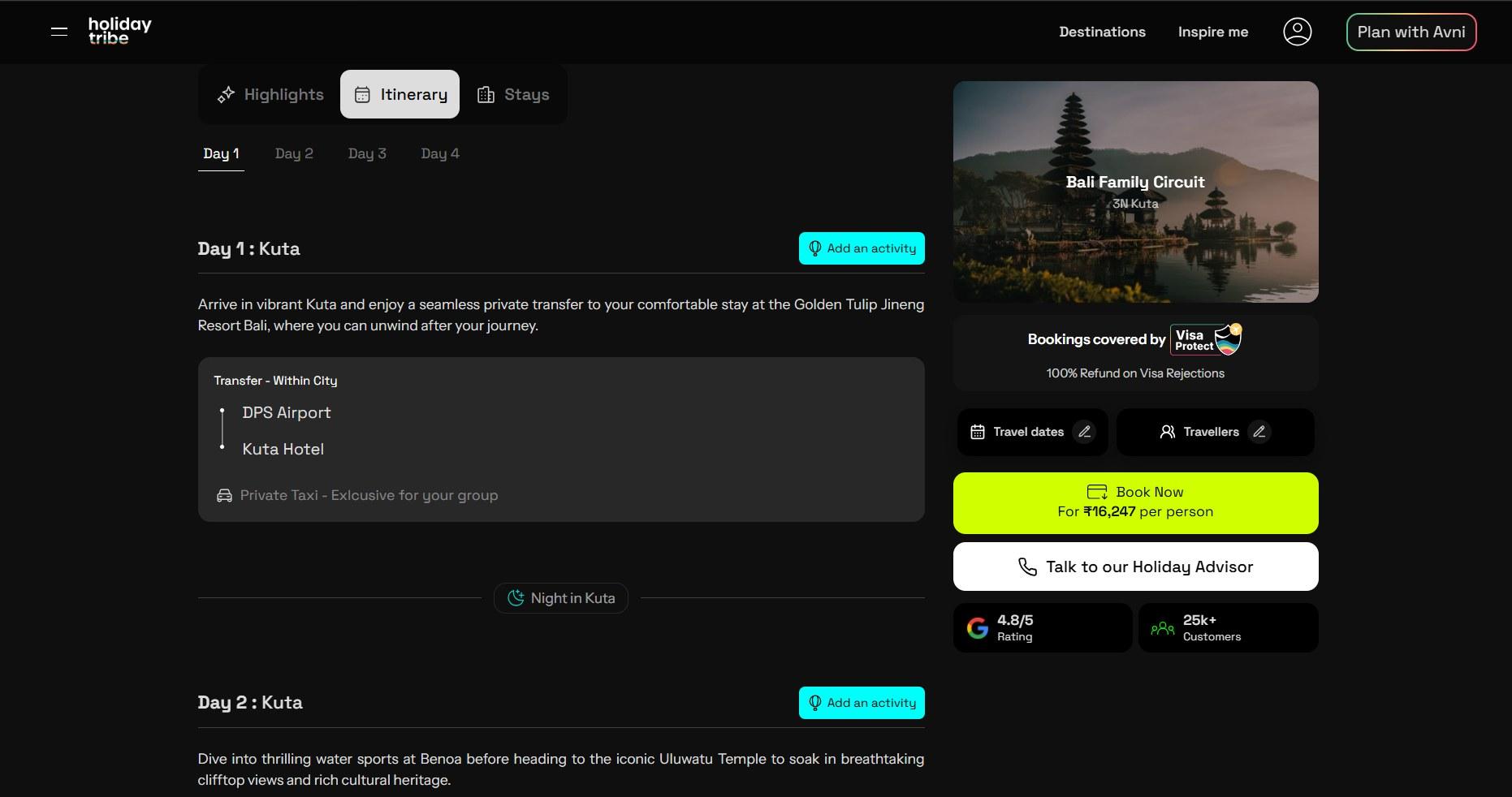
After
- A two-pane layout: the trip on the left, a booking panel on the right.
- Highlights / Itinerary / Stays tabs with day-by-day navigation.
- In-line customisation — add an activity to any day, edit travel dates and travellers.
- Two clear next steps: Book Now with the per-person price, or talk to a holiday advisor.
How it shipped
I coordinated with Engineering and Design on the end-to-end redesign and validated it with a cookie-randomized A/B test.
The result
- Book Now → quotation conversion up ~20%.
- 29% of users built above-default itineraries.
“Self-serve flows in travel can get messy very quickly—balancing complex inventory, pricing logic, and dynamic itineraries while keeping the user experience intuitive is no easy feat. Manit dove right into our package edit feature set, demonstrating a sharp product sense, strong problem-solving skills, and a genuine empathy for traveler pain points.”
AI tooling · self-initiated
The Beat the Price Simulator
The problem
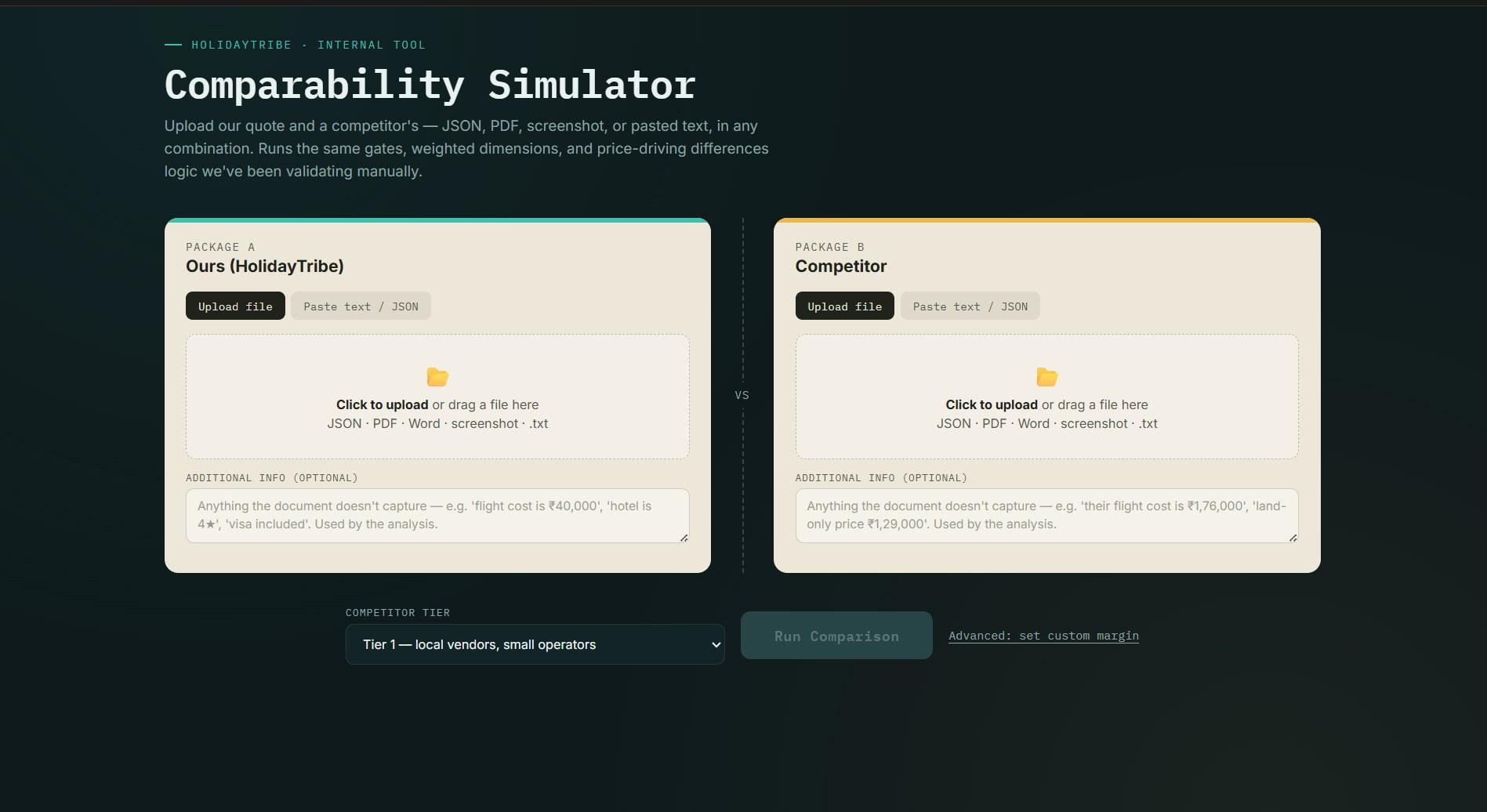
Matching a competitor's quote meant comparing two packages by hand — checking the same gates, weighted dimensions and price-driving differences every time.
What I built
- Self-initiated and solo-built as a Claude skill.
- Parses competitor quotes in any format — PDF, image or link.
- Applies the discount rules for the competitor's tier.
- Auto-logs every comparison to Google Drive via MCP.
The result
Adopted by sales leadership — processing 60 comparisons a week with 40 bookings converted.
Lead generation · Maldives
An app-less WhatsApp funnel
I built a lead-generation funnel for Maldives packages that never asks the traveller to install anything — it runs from a Meta ad straight into WhatsApp (Gallabox).
- Meta Ads
- WhatsApp qualification flow
- Package carousel
- Seller handoff
Safety net
A CRM fallback captures anyone who drops off mid-flow.
Early signal
70% fewer sellers needed per booking.
Next case study · Founder
Housing DTU